September 10, 2010
Twitter This: Crimes Are Virtual But Damages Are Real: World Gathers In Brazil 4 The Congress On Electronic Crimes & Protection http://ellblog.com/?p=2110
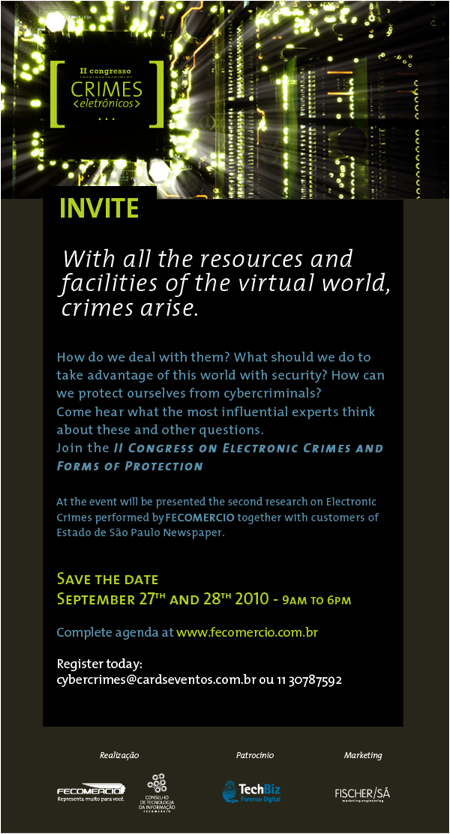
Recently, our very own Fernando M. Pinguelo was able to sit down with Brazillian Cyber Law Attorney Opice Blum for a discussion on the Congress on Electronic Crimes and Protection. Below is a partial transcript of their Question-and-Answer session:
Q: Thank you, Renato, for sitting down with me to discuss the latest developments in tech crimes and what experts like you are doing to help businesses and individuals prevent these crimes and address them when they hit home. Tell me a little bit about your background and the composition of your law practice.
A: My name is Renato Opice Blum and I am a Brazilian Attorney and Economist who specializes in High Tech Law. I am CEO of Opice Blum Attorneys at Law, one of the most respected South American firms. Continue reading »
 No Comments » |


 More...
|
More...
|  Permalink
 Tagged as: Accessibility, Computer Forensics Protocols, Events, Experts, Metadata, Privacy
View more articles implicating: Government Officials, Miscellaneous
June 29, 2010
Citation: Newman v. Borders, Inc., 257 F.R.D. 1 (D.D.C. 2009).
Employee/Employer Implicated: Large Bookstore, Outside Counsel
e-Lesson Learned: Rule 30(b)(6) requests must specify whether electronically stored information retention policies will be within the scope of the deposition testimony sought.
Twitter This: Ask and they shall answer—a deposition notice should define the scope of testimony! --> http://ellblog.com/?p=2101
In Newman v. Borders, Inc., the United States District Court for the District of Columbia held that because plaintiff failed to notify defendant in a deposition notice that questions in a deposition would pertain to the defendant book’s email policies (or any electronically stored information (ESI) in general), plaintiff was not entitled to take further depositions despite the designated witness’s lack of knowledge regarding that subject matter. However, the Court further held that due to both parties’ failures to try hard enough to resolve the dispute and because discovery regarding document retention policies is a legitimate request, defendant was nonetheless ordered to answer specific questions posed by the Court regarding its email retention policies.
The lesson here is twofold: If you are going to depose witnesses regarding ESI, you must put the other party on notice of the scope of the deposition testimony being sought, or risk losing the opportunity to conduct further depositions. But regardless of whether you are the party who asks or the party who answers, you must be sure to make every reasonable effort to resolve discovery disputes. Continue reading »
No Comments » | More...
| Permalink
Tagged as: Accessibility, Cost Sharing & Shifting, Meet & Confer, Procedure
View more articles implicating: In-House Counsel, Outside Counsel
May 23, 2010
Citation: Quon v. Arch Wireless Operating Co., 529 F.3d 892 (9th Cir. 2008)
e-Lesson Learned: Simply instituting an anti-privacy policy is not enough to monitor employee communications. Employers need to ensure that its managers and supervisors are strictly enforcing the anti-privacy policy and not sending contradictory messages.
Twitter This: Beware: Failure to strictly enforce your anti-privacy policies could leave you open to lawsuits --> http://ellblog.com/?p=2095
Is having an anti-privacy policy enough to monitor employer-issued Blackberries® and laptops?
According to the 9th circuit, the answer is a NO!
In Quon v. Arch Wireless Operating Co., 529 F.3d 892 (9th Cir. 2008), the City of Ontario Police Department (“OPD”) had a formal policy governing city-owned computers and associated equipment that limited its use to City related business. It also warned that the users should have no expectation of privacy or confidentiality when using these resources. When the OPD issued pagers to its employees, it clarified that the policy also applied to the use of pagers. Under the OPD’s contract with its service provider, each pager was allotted 25,000 characters, after which it incurred overage charges.
Quon’s supervisor informally allowed employees to pay for their overages thereby avoiding the need to audit the messages. Accordingly, employees paid their share when they exceeded the character limit and avoided an audit. Quon’s repeated overages, however, frustrated the supervisor, who pursuant to the formal policy requested an audit to determine if the exceedances were due to city related business. The audit revealed that many of the messages were personal in nature and often sexually explicit. It also revealed that at least in one instance the pagers were used to undermine a narcotics investigation. Continue reading »
No Comments » | More...
| Permalink
Tagged as: Accessibility, Discoverability, Privacy
View more articles implicating: Owners/Executives, Upper Management
May 3, 2010
Employee/Employer Implicated: Everyone in California and Subject to a lawsuit in California; Inhouse Counsel; Outside Counsel; Information Technology Employees
e-Lesson Learned: Before responding to discovery requests for ESI, counsel should have a comprehensive understanding of his or her client’s information technology systems.
Twitter This: Lawyers must know the ins and outs of their clients IT departments…at least in CA they do. --> http://ellblog.com/?p=2092
On June 29, 2009, Governor Schwarzenegger signed into law California’s Electronic Discovery Act, which is effective immediately. For the most part, the recent eDiscovery amendments to the California Code of Civil Procedure track the federal rules. For example, similar to the federal rules, the California rules use a broad definition of “electronically stored information,” allow requesting parties to inspect, copy and sample ESI, and require both parties to meet and confer regarding ESI discovery issues early in the litigation (in CA this must be done 45 days before a case management conference compared with 21 days under the federal rules).
However, the California amendments depart from the federal rules in a few distinct and important ways. Continue reading »
No Comments » | More...
| Permalink
Tagged as: Accessibility, Meet & Confer, Procedure, Production of Data
View more articles implicating: Miscellaneous
April 22, 2010
Citation: High Voltage Beverages, LLC v. The Coca-Cola Company, 2009 U.S. Dist. Lexis 88259 (W.D.N.C. Sept. 8, 2009)
Employee/Employer Implicated: Counsel, Plaintiffs, Defendants
e-Lesson Learned: The proportionality standard of FRCP Rule 26 governs discovery requests, including e-discovery.
Just because e-discovery is involved does not mean we can disregard the rules applied to traditional discovery. While we must adapt the way we approach discovery because of advancing technology and the decline of the paper-based world, we must not forget that the spirit behind the rules of discovery apply to all discovery, including e-discovery.
In High Voltage, the plaintiff filed a motion to compel the defendant to search for alternative sources beyond the initial production of documents for the selection of the VAULT mark. This would involve having the defendant review an additional 1.5 million pages of documents (17 gigabytes) beyond the 1.7 million pages already produced to the plaintiff. Continue reading »
4 Comments | More...
| Permalink
Tagged as: Accessibility, Consent, Cost Sharing & Shifting, Discoverability, Good Faith, Procedure, Production of Data
View more articles implicating: In-House Counsel, Outside Counsel
April 16, 2010
Citation: Paris Business Products, Inc. v. Genisis Technologies, LLC, 2007 WL 3125184 (D.N.J. Oct. 24, 2007)
e-Lesson Learned: If you destroy discoverable electronic data, you can be subject to an adverse inference jury instruction at trial.
Twitter This: Destroying discoverable e-data can lead to an adverse inference charge at trial --> http://ellblog.com/?p=2078
Dead men tell no tales, but their bodies provide enough evidence to paint a graphic picture. The same is true of deleted files on a computer. Missing files can carry the inference that the evidence was only destroyed because it would have been damaging to the party responsible.
In Paris Business Products, Inc. v. Genisis Technologies, LLC (“Paris”), Genisis Technologies, LLC, (“Genisis”) was subject to a discovery order requiring it to preserve all relevant data on company-owned computer hard drives. Despite this order, Genisis’ executive officers allegedly were responsible for: (1) deleting the company hard drives by reformatting them; and (2) physically removing and destroying some hard drives. Continue reading »
5 Comments | More...
| Permalink
Tagged as: Accessibility, Chain of Custody, Computer Forensics Protocols, Good Faith, Legal Hold/Preservation, Procedure, Production of Data, Sanctions, Spoliation
View more articles implicating: Owners/Executives
March 17, 2010
e-Lesson Learned: Failure to preserve electronically stored information once the duty to preserve evidence has been triggered may lead to spoliation sanctions.
Twitter This: Prison guards sanctioned 4 spoliation, failed 2 preserve vid footage allegedly capturing assault of prisoner -> http://ellblog.com/?p=2039
Can a defendant be subject to discovery sanctions for conduct occurring before discovery even begins? Although this may seem antithetical, correctional officers at a federal prison in New Jersey were sanctioned for spoliating evidence when they were unable to produce videotape footage of an incident involving a prisoner during discovery of the Section 1983 action arising out of the incident.
In Kounellis v. Sherrer, 529 F.Supp. 2d 503 (D.N.J. 2008), plaintiff prisoner brought a Section 1983 action against correctional officers and prison officials after the officers allegedly assaulted the prisoner in retaliation for his filing of administrative complaints against the officers. After the alleged assault, the prisoner repeatedly requested a copy of the video surveillance footage from a camera in the area of the alleged assault. Defendants never provided the prisoner with the copy. Continue reading »
8 Comments | More...
| Permalink
Tagged as: Accessibility, Chain of Custody, Discoverability, Production of Data, Sanctions, Spoliation
View more articles implicating: Document Custodians, Employees, Government Officials
March 15, 2010
Citation: Southeastern Mech. Servs. v. Brody, No. 8:08-CV-1151, 2009 U.S. Dist. LEXIS 85430 (M.D. Fla. Aug. 31, 2009)
Employee/Employer Implicated: Employees, In-House Counsel
e-Lesson Learned: When the court orders your client to preserve data, don’t let employees wipe their BlackBerrys® before turning them in. A wiped BlackBerry® smartphone could translate into “bad faith” and might just induce a court to impose spoliation sanctions.
Twitter This: Learn a lesson from Smuckers: When the court says “preserve,” that includes BlackBerrys and other handhelds -> http://ellblog.com/?p=2021

Suddenly find yourself at the wrong end of a trade secrets litigation? Heed this advice: When the court says “preserve,” that means documents, files, data, and BlackBerry® smartphones. Thus, be sure to instruct your clients not to wipe the memory from their BlackBerrys or other handheld devices before turning them in; or else, your client may be subject to sanctions.
The defendants in a trade secrets theft case learned this lesson the hard way when the District Court in Florida slapped them with sanctions after they turned in freshly “wiped” BlackBerrys. The court interpreted the freshly sanitized BlackBerrys as evidence of bad faith that justified sanctions. But you might be thinking: “A BlackBerry wiped clean? Who cares! All the e-mails the other side could possibly want are readily available on the server.” This type of thinking could get you in trouble. Let’s see why.
Continue reading »
6 Comments | More...
| Permalink
Tagged as: Accessibility, Computer Forensics Protocols, Experts, Legal Hold/Preservation, Sanctions, Spoliation
View more articles implicating: Employees, In-House Counsel
February 28, 2010
Citation: Optowave Co., Ltd v. Nikitin, No. 6:05-cv-1083-Orl-22DAB (D. Fla. Filed Nov. 7, 2006)
e-Lesson Learned: After being placed on notice of a possible lawsuit, don’t destroy potentially relevant evidence by reformatting employee hard drives.
Twitter This: Holding off on wiping the hard drives of key document custodians till after the big case is over is a good idea http://ellblog.com/?p=1990
Tech-savvy business owner Dmitri Nikitin received a judicial tongue-lashing and an adverse inference instruction after he destroyed emails potentially relevant to a pending lawsuit brought by a Korean corporation. Not buying Nikitin’s “hackers” defense, the Court said that Plaintiff Optowave was entitled to an adverse jury instruction at trial against Nikitin’s company Precision Technology Group. “This sanction,” the Judge wrote, “will serve to cure the unacceptable actions of Nikitin, while allowing the case to be decided on the merits.”
Continue reading »
5 Comments | More...
| Permalink
Tagged as: Accessibility, Computer Forensics Protocols, Cost Sharing & Shifting, Good Faith, Legal Hold/Preservation, Procedure, Production of Data, Spoliation
View more articles implicating: Owners/Executives
February 25, 2010
Citation: Bray & Gillespie Management LLC v. Lexington Insurance Co., 2009 WL 2407754 (M.D. Fl. 2009)
Employee/Employer Implicated: Outside Counsel, Senior Management, In-house Legal Assistant
e-Lesson Learned: Failure to produce Discovery is bad; violating court orders is worse; being sanctioned for both is the worst.
Twitter This: Don’t Throw eDiscovery Rocks If You Live In A Digital Glass House --> http://ellblog.com/?p=1980
Fool me once, shame on you. Fool me twice, more shame on you. Fool me three times and you are in some hot water! Regardless of whether you are (or represent) the plaintiff or the defendant, your discovery obligations are the same: Absent a valid, court-sanctioned objection, you must comply with your adversary’s discovery demands.
While electronically stored information (ESI) may be a rather esoteric concept for many of us (perhaps most), in the eyes of the law and the court, ESI is just as real as traditional paper documents; and one’s failure to search for and disclose ESI in a timely manner could lead to big problems for an attorney and the client. In one case, it may have cost one company $25 million.
Continue reading »
3 Comments | More...
| Permalink
Tagged as: Accessibility, Cost Sharing & Shifting, Discoverability, Experts, Good Faith, Procedure, Production of Data, Sanctions
View more articles implicating: In-House Counsel, Outside Counsel, Upper Management